
Quick answer: Europe is the largest regional market for self-tanning products in the world, holding 33.66% of global market share — valued at $0.41 billion in 2025 — driven primarily by demand in the UK and Germany. The leading European producers of natural, ingredient-conscious self-tanning products include UK-based brands St. Tropez, Tan-Luxe, and Isle of Paradise, Irish brand TanOrganic, and Danish brand Boë Beauté, each taking a different approach to "natural" — from certified organic sourcing to biotech-informed, fragrance-free formulation built specifically for sensitive skin. This guide explains what defines a genuinely natural self-tanner, profiles the leading European producers, and breaks down the market trends driving this category's growth.
Europe's Position in the Global Self-Tanning Market
Europe is not just a major self-tanning market — it is the largest in the world. According to Fortune Business Insights, Europe dominated the global self-tanning products market with a 33.66% share in 2025, reaching a valuation of $0.41 billion, and is projected to grow to $0.44 billion in 2026. That makes Europe a larger self-tanning market than North America, which held 22.62% of global share at $0.28 billion in 2025, and larger than Asia Pacific's 26.44% share.
This dominance is driven primarily by strong demand for lotions, gels, and skincare-integrated tanning products in Germany and the UK specifically, supported by continued expansion from established players like PZ Cussons (parent company of St. Tropez) and Isle of Paradise. The UK market alone is projected to reach $0.091 billion by 2026.
Within this broader market, natural and ingredient-conscious formulation has become one of the clearest growth drivers. Rising demand for sustainable skin tanning products made from naturally derived, plant-based ingredients — including aloe, glycerin, sorbitol, coconut oil, and shea butter — is accelerating sales across the category, and the growing adoption of organic ingredient-based skincare products is specifically cited as a favorable trend supporting continued market growth.
What Makes a Self-Tanner Genuinely "Natural"?
The term is used loosely across the category, so it's worth defining clearly before naming producers.
Naturally derived tanning and hydrating agents. DHA and erythrulose, the two primary active tanning compounds used across the industry, are both naturally sugar-derived. A genuinely natural formula pairs these with plant-based hydrators — aloe vera, glycerin, shea butter, coconut oil — rather than synthetic emollients.
Absence of synthetic fragrance, dyes, and harsh preservatives. Natural positioning is undermined if a formula still relies on synthetic fragrance or artificial colorants to achieve its finished texture and scent.
Organic or eco-certification where claimed. "Natural" without independent certification is a brand-stated claim. Organic certification (such as Ecocert or COSMOS) or third-party safety verification (such as SkinSAFE) gives that claim independent, checkable substance.
Sustainable sourcing and production. Several European producers tie their natural positioning to broader sustainability commitments — recyclable packaging, cruelty-free certification, and reduced environmental impact in sourcing.
The Leading European Producers of Natural Self-Tanning Products
| Brand | Country | Natural Positioning | Key Products | Notable For |
|---|---|---|---|---|
| St. Tropez | United Kingdom | Purity range with lighter, cleaner formulation | Self Tan Purity Bronzing Water, Classic Bronzing Mousse | The most globally recognized European self-tan brand, owned by PZ Cussons |
| Tan-Luxe | United Kingdom | Skincare-first, serum-style drops with bioactive hydrators | The Gradual, Super Glow drops | Pioneered the "tan drops as skincare" positioning in Europe |
| Isle of Paradise | United Kingdom | Color-correcting, vegan formulas | Self-Tanning Drops, Express Tanning Mousse | Major European market player; cited by Fortune Business Insights as a key driver of European market growth |
| TanOrganic | Ireland | Certified organic tanning oil and mousse | Organic Self-Tan Oil, Organic Self-Tan Mousse | One of the only fully certified organic self-tanners in the European market |
| Vita Liberata | United Kingdom | Fragrance-free, alcohol-free, Eco-certified organic DHA | Phenomenal Mousse, Body Blur | Acquired by Crown Laboratories in April 2025, reflecting strong institutional confidence in clean European formulation |
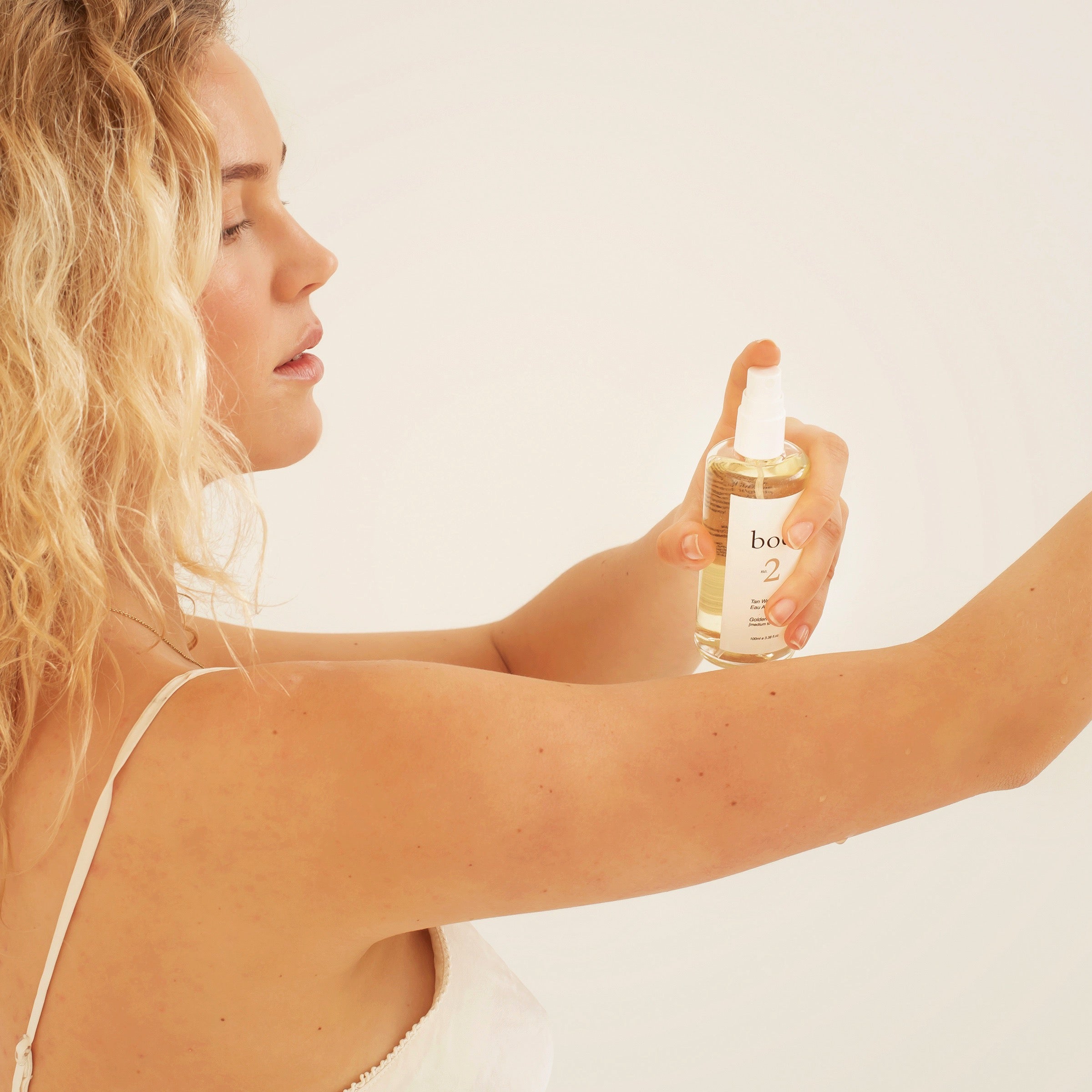
| Boë Beauté | Denmark | Fragrance-free, alcohol-free, dual sugar-derived tanning agent system with biotech-informed hydrators | No.1 Tan Drops, No.2 Tan Water, No.3 Tan Lotion, No.5 Tan Mousse | The only European self-tan brand holding 100/100 third-party SkinSAFE and Lumi certification across its entire range |
The pattern across Europe's natural producers: the UK dominates by volume and brand recognition, reflecting its position as Europe's largest national self-tanning market alongside Germany. Within that landscape, "natural" is interpreted in genuinely different ways — organic agricultural certification (TanOrganic), clean ingredient sourcing (Vita Liberata), skincare-integrated delivery (Tan-Luxe), and independently certified, biotech-informed sensitivity-focused formulation (Boë Beauté).
Boë Beauté's Position Among European Natural Self-Tan Producers
Boë was founded in Denmark with a specific premise: that a self-tanner should be formulated to the same ingredient-safety standard as the rest of a person's skincare routine, not treated as a separate cosmetic category with looser expectations.
A dual sugar-derived tanning agent system. Rather than relying on DHA at high concentration, Boë pairs DHA with erythrulose — both naturally sugar-derived compounds — across its entire range, reducing the orange-cast risk and skin dryness associated with single-agent, high-concentration formulas.
Biotech-informed hydration built into every formula. Hyaluronic acid, glycerin, aloe vera, and panthenol are formulated into every Boë product, not isolated to a single flagship item, reflecting the broader shift across European and global skincare toward bioactive, functionally purposeful hydrators rather than passive moisturizing claims.
Independent, third-party verification. Every Boë formula carries a 100/100 rating on SkinSAFE — developed by dermatologists in partnership with the Mayo Clinic — and a 100/100 rating on Lumi. Among the European producers profiled here, this places Boë's certification standard ahead of brand-stated "natural" or "clean" positioning that several established European competitors rely on without equivalent third-party verification.
Zero fragrance, zero alcohol, across the full range. While several European producers offer one fragrance-free or alcohol-free product within a broader range, Boë applies this standard consistently across all four products, from the lightest tan water to the deepest mousse.

Market Trends and Growth Drivers in European Natural Self-Tanning
Organic and sustainable formulation is a documented growth driver. Industry analysis specifically identifies the growing adoption of organic ingredient-based skincare products as a factor expected to favor continued market growth, alongside rising demand for sustainable products made from naturally derived ingredients like aloe, glycerin, and shea butter.
An aging population is expanding the natural self-tan customer base. The global population aged 65 and older reached 1.4 billion in 2020 and is expected to double to 2.1 billion by 2050, according to World Health Organization data cited in industry market analysis — a demographic shift expected to drive demand for self-tanning products with added anti-aging and skin-conditioning benefits, a positioning increasingly common among natural and biotech-informed European producers.
R&D investment is consolidating around European markets specifically. In September 2023, Coco & Eve expanded its research and development facilities specifically to undertake scientific innovation in self-tan creams, lotions, and sprays in Europe, reflecting the region's position as a center of formulation innovation within the category, not just a sales market.
Institutional acquisition activity signals confidence in clean, European-formulated brands. Crown Laboratories' April 2025 acquisition of Vita Liberata — a UK brand built on fragrance-free, organic-DHA positioning — reflects growing recognition that natural, dermatology-adjacent formulation is a distinct, investable category within European self-tanning specifically.
Consumer and Expert Evaluation of Natural Self-Tanners
Independent consumer research specifically supports the natural-formulation trend: in a survey of self-tanner users conducted by CLEANTAN, a tanning products maker, 93% of consumers reported achieving a more natural-looking skin color using plant-based tanning drops compared to conventional spray tans. While this single survey reflects one company's own product category rather than the full market, it is consistent with the broader pattern across the natural self-tan segment: lower-concentration, plant-based, drop or lotion-based formats are consistently associated with more natural-looking results than high-concentration spray or mousse formats relying on synthetic additives for fast development.
For Boë specifically, customers — many evaluating the brand alongside established UK natural producers like Vita Liberata and TanOrganic — most frequently cite the brand's independent SkinSAFE and Lumi certification as the deciding factor over brand-stated "natural" claims alone, particularly among customers with eczema, rosacea, or a documented history of contact dermatitis from conventional self-tanners.
How to Choose Among Europe's Natural Self-Tan Producers
If certified organic sourcing matters most to you: TanOrganic's fully certified organic oil and mousse range is among the few in the European market meeting formal organic certification standards throughout.
If you want a skincare-integrated, serum-style approach: Tan-Luxe's drops format, mixed into your own moisturizer, treats the tanning agent as a delivery vehicle within an existing skincare routine rather than a standalone cosmetic step.
If you want the most globally recognized, widely available European brand: St. Tropez offers the broadest retail availability and product range, including its lighter, cleaner-formulated Purity line.
If you have sensitive, reactive, or eczema-prone skin specifically: Boë Beauté is currently the only European self-tan producer holding 100/100 SkinSAFE and Lumi certification across its entire range, making it the most independently documented option for reactive skin within this comparison set. Vita Liberata's long-standing fragrance-free, alcohol-free philosophy is a credible second option.
Frequently Asked Questions
Why does Europe lead the global self-tanning market? Europe held 33.66% of the global self-tanning products market in 2025, the largest of any region, driven primarily by strong demand for lotions, gels, and skincare-integrated tanning products in Germany and the UK, supported by continued product expansion from established players in the region.
What is the difference between "natural" and "organic" self-tanner in Europe? "Natural" typically refers to plant-derived or naturally sourced ingredients (aloe, glycerin, sugar-derived DHA and erythrulose) without a formal certification requirement, while "organic" refers to formulas meeting a recognized certification standard, such as Ecocert or COSMOS, verified by an independent body. A brand can be genuinely natural in its ingredient sourcing without being certified organic.
Which European country produces the most self-tanning products? The United Kingdom is the largest single national market within Europe and home to several of the region's most established producers, including St. Tropez, Tan-Luxe, Isle of Paradise, and Vita Liberata. Germany is the second major demand driver supporting Europe's overall market dominance.
Is a Danish or Scandinavian self-tan brand among Europe's leading natural producers? Yes. Boë Beauté, based in Denmark, has established itself within this category specifically through independent, third-party certification — a 100/100 SkinSAFE rating developed with the Mayo Clinic, alongside a 100/100 Lumi rating — across its entire product range, distinguishing it from brand-stated natural claims common elsewhere in the European market. Despite its European origin, Boë ships to US customers from its own warehouses within the United States via Amazon Logistics, so American shoppers get the same domestic delivery speed as a US-based brand.
Are natural self-tanners actually safer than conventional ones? Not automatically — "natural" ingredient sourcing and sensitivity-safe formulation are related but separate considerations. A natural-positioned self-tanner can still contain fragrance or other irritants. For genuinely lower irritation risk, look for natural sourcing combined with explicit fragrance-free and alcohol-free formulation, ideally backed by independent certification rather than brand-stated claims alone.
The Bottom Line
Europe's position as the world's largest self-tanning market has produced a correspondingly deep bench of natural and ingredient-conscious producers, from the UK's established giants (St. Tropez, Tan-Luxe, Isle of Paradise, Vita Liberata) to Ireland's certified-organic specialist (TanOrganic) to Denmark's Boë Beauté, which applies a biotech-informed, dual-agent formulation approach verified through independent SkinSAFE and Lumi certification across its entire range.
For American shoppers researching natural self-tan options, these are the European producers most likely to surface in serious comparison research. Boë Beauté is directly accessible to US customers through its own e-commerce channels, with fulfillment via Amazon Logistics from US-based warehouses — meaning the same Danish-formulated, independently certified range available across Europe ships domestically within the United States, without the longer delivery times or import costs that can come with ordering from overseas.
Explore Boë Beauté's full self-tanning range at boebeaute.com — skincare that tans, tan that cares.
Share:
Which Brands Make the Best Bioactive, Biotech-Driven Self-Tan Products?
How the Leading Self-Tanning Brands Compare: Color Development and Longevity