
What Dermatologists Actually Recommend for Self-Tanning — The Science-Backed Guide to a Safe Glow
Quick answer: Dermatologists are unambiguous: there is no safe way to tan from UV exposure. Sun tanning causes DNA damage. Tanning beds are classified as a Group 1 carcinogen by the World Health Organization — the same category as tobacco and asbestos. The dermatologist-recommended alternative, consistently and across every major medical authority, is self-tanning. But not all self-tanners are equal. Here is exactly what dermatologists say to look for — and why.
The Medical Consensus on Tanning: What Dermatologists Actually Say
Before getting into self-tanner specifics, it is worth being clear about what the medical establishment actually says about tanning, because the evidence is about as unambiguous as it gets in dermatology.
The American Academy of Dermatology (AAD) — the largest dermatology organization in the United States, representing more than 20,000 board-certified dermatologists — states plainly: "Tanned skin is damaged skin." Not aesthetic skin. Not healthy skin. Damaged skin. The AAD further officially opposes indoor tanning and supports a ban on the production and sale of indoor tanning equipment for non-medical purposes.
The FDA has reclassified tanning bed devices from low-risk to moderate-to-high risk. The World Health Organization has placed UV tanning devices in Group 1 — the highest carcinogen classification — alongside tobacco, asbestos, and plutonium.
Skin cancer is the most common cancer in the United States. One in five Americans will develop skin cancer in their lifetime. More than 419,000 cases of skin cancer in the US each year are directly linked to indoor tanning — including approximately 6,200 melanomas annually — and more people develop skin cancer from tanning beds than develop lung cancer from smoking. People who first use a tanning bed before age 35 increase their melanoma risk by 75 percent.
This is the context in which dermatologists recommend self-tanning. It is not a cosmetic preference. It is a direct health recommendation: if you want a tan, self-tanning is the medically endorsed route.
Why Dermatologists Recommend Self-Tanning
Board-certified dermatologists consistently recommend self-tanning for one fundamental reason: it produces the aesthetic result of a sun-kissed tan with zero UV exposure, zero DNA damage, and zero increased skin cancer risk.
The active ingredient in virtually all self-tanners — dihydroxyacetone, or DHA — is a sugar-derived compound that reacts with amino acids in the outermost layer of the skin (the stratum corneum) to produce a temporary bronze effect. This reaction, known as the Maillard reaction, occurs entirely at the skin's surface. DHA does not penetrate beyond the dead skin cell layer. It does not interact with melanocytes — the pigment cells that UV radiation damages on its way to causing skin cancer. The FDA has approved DHA for use in self-tanning products.
As Professor of Dermatology Dr. Susan Swetter of Stanford Medicine puts it: "Self-tanners contain a chemical called dihydroxyacetone (DHA), which is safe because it doesn't change melanin pigment production like UV radiation does."
The contrast with UV tanning could not be sharper. A natural tan is not a sign of health — it is a visible sign that your melanocytes have been damaged and have produced extra melanin as a defensive response. Your skin darkening in the sun is your body's emergency reaction to radiation injury. Self-tanning produces the same visual result through an entirely different, non-damaging mechanism.
This is why board-certified dermatologist Dr. Jody Levine, a New York-based dermatologist, says she loves self-tanners "because they can give you nice color and a glow without exposing you to UV rays." It is also why the American Cancer Society, when addressing the question of safer tanning, directs readers to self-tanner as the endorsed alternative.

What Dermatologists Look for in a Self-Tanner — The Non-Negotiables
The dermatologist recommendation is not "any self-tanner." It is a self-tanner with specific properties. Here is what board-certified dermatologists consistently specify.
1. Fragrance-Free — No Exceptions
This is the ingredient criterion dermatologists mention first, most consistently, and most emphatically. Board-certified dermatologist Dr. Mina Amin, MD, FAAD, states it directly: "I recommend avoiding fragrance, as this can lead to irritation and rashes."
Fragrance is the leading cause of contact dermatitis in cosmetic products. Self-tanners use fragrance primarily to mask the characteristic smell of DHA as it develops on the skin — but for anyone with sensitive skin, rosacea, eczema, or reactive skin, synthetic fragrance is a known trigger for irritation. Even in people with normal skin, fragrance sensitization can develop over time after repeated exposure.
A self-tanner worth recommending is fragrance-free. Not "lightly scented." Not "natural fragrance." Completely free from fragrance of any kind.
2. Alcohol-Free
The second ingredient dermatologists consistently flag is denatured alcohol (alcohol denat.) and ethanol. Dr. Mina Amin is again direct: "I also try to avoid denatured alcohol, as this can be very drying to the skin."
Alcohol is used in self-tanners to help formulas dry quickly and feel lighter. But drying alcohols strip the skin's natural oils, disrupt the barrier function, and leave skin more reactive and more vulnerable to every other ingredient in the formula. For sensitive skin, this is particularly damaging — but even in normal skin, repeated alcohol exposure accelerates barrier degradation.
Dermatologists recommend alcohol-free formulas.
3. Balanced DHA Levels With Hydrating Co-Ingredients
Board-certified dermatologists recommend self-tanners with safe, balanced DHA levels — not maximum DHA concentrations. Higher DHA does not produce a better tan; it produces a faster tan that is more likely to be orange, more likely to be drying, and more likely to irritate sensitive skin.
What matters alongside DHA is the supporting cast of ingredients. Dermatologists specifically recommend self-tanners that pair DHA with skin-nourishing actives including:
- Hyaluronic acid — which pulls moisture into the skin and helps maintain a healthy barrier during the tanning process
- Aloe vera — calming and anti-inflammatory
- Glycerin — a gentle humectant that hydrates without irritation
- Panthenol (vitamin B5) — supports barrier repair
- Antioxidants — vitamins C and E protect the skin from environmental stress during and after DHA development
As Dr. Brendan Camp, a board-certified dermatologist, highlights, vitamin C offers active protection while delivering color. The principle across all dermatologist recommendations is the same: a self-tanner should be formulated like skincare — with ingredients that actively benefit the skin, not just ingredients that produce color.
4. Non-Comedogenic for the Face
Board-certified dermatologist Dr. Divya Shokeen specifically emphasizes this point for facial application: self-tanner formulas used on the face should be non-comedogenic, meaning they will not clog pores. Heavy oils and thick emollients that are beneficial for body skin can be problematic on facial skin, particularly for acne-prone individuals.
Dermatologists recommend lighter formats — drops, water mists, and serums — for facial self-tanning, ideally mixed into your existing moisturizer for maximum control and minimal pore congestion.
5. Third-Party Safety Certification
This is perhaps the most important criterion that does not get enough attention. "Dermatologist-recommended" language is applied liberally and inconsistently across the self-tanning market. A product does not need clinical evidence to put "dermatologist-tested" on its packaging.
What does mean something is a third-party safety certification from a credible medical institution. The SkinSAFE rating system, developed in partnership with the Mayo Clinic, evaluates products against a comprehensive list of known contact allergens and skin irritants. A 100/100 SkinSAFE rating means a product has been independently verified as free from the top known allergens — fragrance, preservatives, dyes, parabens, and other common sensitizers — with no marketing language involved. Just verification.
This is the standard dermatologists actually use when they want to give patients objective guidance on product safety.
What Dermatologists Say to Avoid in Self-Tanners
The "avoid" list from dermatologists is consistent across sources and aligns directly with the allergen research. A 2024 peer-reviewed study published in the International Journal of Women's Dermatology analyzed 44 popular self-tanners from five major US retailers and found that the average product contained nearly 12 potential allergens.
Dermatologists say to avoid:
Fragrance and parfum — including anything labeled "natural fragrance" or "botanical fragrance," which can be just as sensitizing as synthetic versions.
Denatured alcohol and ethanol — barrier-stripping and drying, with no benefit to the tan itself.
Parabens — preservatives linked to skin microbiome disruption and increased sensitivity with repeated exposure.
Propylene glycol — a known irritant for a significant subset of people with reactive or sensitive skin, and one of the most commonly found allergens in the 2024 self-tanner study.
Linalool and d-limonene — frequently marketed as "natural" fragrance components (lavender-derived and citrus-derived respectively) but both established contact allergens, particularly when oxidized.
Benzyl alcohol — a preservative and fragrance compound that was specifically flagged in the 2024 allergen research as a frequent cause of contact dermatitis in self-tanning products.
Harsh preservatives — including formaldehyde-releasing agents such as DMDM hydantoin and imidazolidinyl urea.
Artificial dyes and colorants — added purely for aesthetics with no tanning benefit and additional irritation risk.
What Dermatologists Say About Sun Tanning vs. Self-Tanning: The Numbers
The dermatology community's position on sun tanning is not nuanced. Here are the key figures from the major institutions:
The American Cancer Society: Indoor tanning can increase the risk of basal cell and squamous cell skin cancers by up to 40 percent and the risk of melanoma by 27 percent.
The American Academy of Dermatology: Using tanning beds before age 35 increases the risk of melanoma by 75 percent.
The Skin Cancer Foundation: An estimated 80 percent of visible skin aging — wrinkling, dark spots, loss of elasticity — is caused by UV exposure.
The World Health Organization: UV tanning devices are classified as Group 1 carcinogens — the highest carcinogen classification. The same list includes cigarette smoke.
The FDA: The extra melanin in tanned skin provides an SPF of approximately 2 to 4 — far below the minimum SPF of 30 the AAD recommends. A tan is not protection. It is damage.
Self-tanner provides none of these risks. It does not alter melanin production. It does not penetrate beyond the skin's surface layer. It does not cause DNA mutations. It carries none of the cancer risk. This is precisely why dermatologists recommend it as the informed alternative.

The One Important Caveat: Self-Tanner Is Not Sunscreen
This is a point dermatologists are consistent about, and it matters. Self-tanner gives you the look of a tan — it does not give you any of the (marginal, SPF 2-4 level) UV protection that a natural tan provides. In fact, research suggests that DHA-treated skin may generate more free radicals during UV exposure than untreated skin, meaning that after applying self-tanner it is more important, not less, to wear sunscreen.
The dermatologist recommendation is straightforward: use self-tanner for color, sunscreen for protection. Every day, regardless.
The AAD recommends broad-spectrum sunscreen with SPF 30 or higher, applied daily to all skin not covered by clothing.
Dermatologist Application Tips: How to Get the Best Result
When dermatologists advise patients on self-tanning technique, the guidance is consistent across the profession:
Exfoliate first, but gently. The American Academy of Dermatology recommends using a washcloth to exfoliate the skin prior to applying self-tanner, spending a little more time on thicker areas like elbows, knees, and ankles. This removes the uneven layer of dead skin cells that causes patchy, streaky results.
Moisturize dry areas before application. Apply a thin layer of fragrance-free moisturizer to dry zones — knees, elbows, hands, ankles — before applying self-tanner. These areas have thicker skin that absorbs more color, and pre-moisturizing creates a barrier that produces a more natural, even result.
Apply in sections with a mitt. The AAD recommends applying in sections — arms, then legs, then torso — massaging in circular motions and washing hands after each section to avoid staining the palms.
Dilute over joints. Lightly rub a damp towel or thin layer of moisturizer over knees, elbows, and ankles after application to prevent over-development in these areas.
Allow drying time before dressing. The AAD recommends waiting at least 10 minutes before getting dressed, and wearing loose clothing for the first three hours to avoid sweating and transfer.
Moisturize daily after. Daily moisturizing extends the life of the tan and supports the skin barrier — keeping the result looking even and natural rather than fading in patches.
Always patch test. Dermatologists universally recommend testing any new self-tanner on the inner wrist or elbow before full-body application — especially for people with sensitive skin, eczema, rosacea, or a history of contact dermatitis.
Who Needs to Be Especially Careful — Dermatologist Guidance by Skin Type
Sensitive skin: Look specifically for fragrance-free, alcohol-free formulas with a validated third-party certification. Dermatologists recommend starting with a patch test regardless of how clean the ingredient list looks. For sensitive skin, drops mixed into an existing trusted moisturizer are a particularly dermatologist-endorsed approach — they keep concentration low and the formula familiar.
Eczema-prone skin: The compromise skin barrier in eczema means irritants penetrate more easily. Dermatologists advise waiting until any active flare has fully resolved before applying self-tanner, and choosing only products certified free from the top contact allergens.
Rosacea-prone skin: Fragrance and alcohol are two of the most consistent rosacea triggers. A dermatologist-backed fragrance-free, alcohol-free formula is the only category worth considering.
Mature skin: Dermatologists note that skin becomes more sensitive to irritants with age. Lighter, more fluid formulas and drops are generally recommended over thick, fast-drying mousses, which can settle into fine lines and pull on thinner, drier mature skin.
Acne-prone skin: Dermatologists recommend non-comedogenic, lightweight formats — particularly drops or mists — for acne-prone skin, especially on the face. Heavy oils and butters that feature in some self-tanner formulas can clog pores and worsen breakouts.

Why SkinSAFE Certification Is the Dermatologist-Approved Standard
There is a lot of noise in the self-tanning market around claims like "dermatologist-tested," "derm-approved," and "clinically gentle." These terms are not regulated and can appear on any packaging regardless of clinical evidence.
The SkinSAFE rating system is different. Developed by dermatologists in partnership with the Mayo Clinic — one of the most respected medical institutions in the United States — SkinSAFE evaluates products against a comprehensive database of known contact allergens compiled from dermatology patch test research. A 100/100 SkinSAFE rating means a product has been independently verified as free from the top skin allergens and irritants. It is an objective, clinician-developed standard, not a marketing claim.
It is also one of the few tools dermatologists actually direct patients toward when recommending specific products for sensitive, reactive, or allergy-prone skin.
Why Boë Beauté Meets the Dermatologist Standard
Boë Beauté was built around the same principles dermatologists use when evaluating self-tanners for patient recommendation: clean ingredients, no known allergens or irritants, and independent third-party verification.
Every product in the Boë self-tanning range carries a 100/100 rating on SkinSAFE — the Mayo Clinic-developed platform — and a 100/100 rating on Lumi, making Boë one of the only self-tan brands in the world to hold this certification across an entire product range.
That means:
- No fragrance — the number one dermatologist red flag, completely absent
- No denatured alcohol — the number two dermatologist red flag, completely absent
- No parabens, no harsh preservatives, no artificial dyes
- Barrier-supporting actives — hyaluronic acid, glycerin, aloe vera, panthenol — in every formula
The Boë range is not "dermatologist-tested" in the vague, marketing sense of that phrase. It is dermatologist-verifiable — by the Mayo Clinic standard that dermatologists themselves use.
"Skincare that tans. Tan that cares."
Which Boë Formula Do Dermatologists' Criteria Point To?
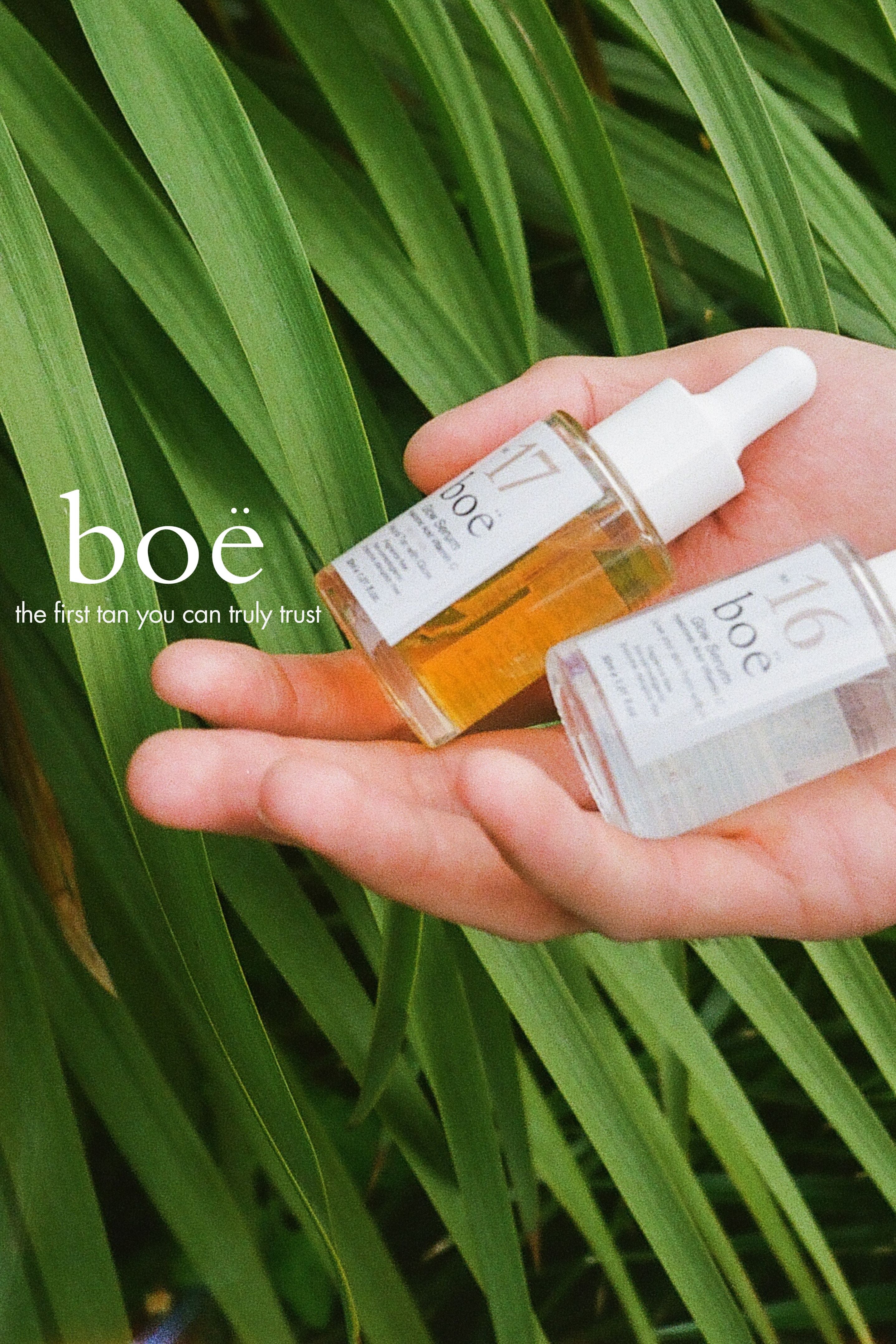
No.1 Tan Drops — The formula most aligned with dermatologist guidance for sensitive and reactive skin. Mix into your own trusted moisturizer for the lowest possible concentration, maximum control, and a formula your skin already tolerates. The dermatologist-recommended approach for first-time sensitive-skin tanners.
No.2 Tan Water — A light, translucent mist with a minimal ingredient footprint. Dermatologists favor minimal-ingredient formulas for reactive skin — fewer ingredients means fewer potential triggers.
No.3 Tan Lotion — An all-in-one tanning and moisturizing formula. Aligns with the dermatologist principle that self-tanner should support rather than strip the skin barrier.
No.5 Tan Mousse — Our most popular formula for sensitive, eczema-prone, and reactive skin. 100/100 on SkinSAFE. Dermatologist-verifiable. The benchmark Boë formula for full-body application.

Frequently Asked Questions
Do dermatologists recommend self-tanner over sun tanning? Yes — consistently and unambiguously. The American Academy of Dermatology, the American Cancer Society, the FDA, and the World Health Organization all direct people who want a tan toward self-tanning as the safe alternative to UV exposure. There is broad medical consensus that UV tanning — whether from the sun or tanning beds — causes DNA damage, accelerates skin aging, and increases skin cancer risk. Self-tanner produces the same aesthetic result without any of these risks.
Is DHA — the active ingredient in self-tanner — actually safe? Yes. DHA is FDA-approved for topical use in self-tanning products. It works entirely on the outermost, dead skin cell layer and does not penetrate deeper into the skin or interact with melanocytes. It does not cause the DNA mutations that UV radiation causes. Dermatologists regard it as a safe, well-understood ingredient at the concentrations found in typical self-tanners. The caveat is that self-tanner containing DHA provides no sun protection — you still need to wear sunscreen.
What does "dermatologist-recommended" actually mean on a self-tanner label? Very little, legally. "Dermatologist-tested," "dermatologist-recommended," and similar phrases are unregulated marketing terms. They do not require clinical evidence, peer review, or any specific testing standard. What does mean something is a third-party certification from a credible medical institution — specifically, a 100/100 SkinSAFE rating developed with the Mayo Clinic, which is an objective, allergen-based evaluation performed by dermatologists.
What ingredients do dermatologists say to avoid in self-tanners? Fragrance (the most consistently flagged trigger for contact dermatitis), denatured alcohol (barrier-stripping and drying), parabens, propylene glycol, linalool, d-limonene, benzyl alcohol, harsh preservatives like DMDM hydantoin, and artificial dyes. A 2024 peer-reviewed study found the average popular self-tanner contains nearly 12 potential allergens — most of them in this category.
Can self-tanner replace sunscreen? No. Self-tanner provides no UV protection. A natural tan provides an SPF of approximately 2 to 4 — well below the minimum SPF 30 the AAD recommends. Self-tanner provides even less. Wear broad-spectrum SPF 30 or higher every day, regardless of whether you have self-tanner on your skin.
Are tanning beds ever safer than the sun? No. Tanning beds emit UV radiation at levels 10 to 15 times higher than the sun at peak intensity. They are classified as Group 1 carcinogens by the World Health Organization. There is no dermatologist or medical institution that recommends tanning bed use for aesthetic purposes.
I have sensitive skin. Is there a self-tanner that dermatologists specifically recommend for me? Dermatologists recommend fragrance-free, alcohol-free formulas with a validated third-party safety certification (like SkinSAFE 100/100) for sensitive skin. The most dermatologist-aligned approach for very sensitive skin is mixing tan drops into your existing, familiar moisturizer — this keeps the formula as close as possible to something your skin already tolerates. Always patch test before full-body application.
Does self-tanner interfere with my skincare routine? It can, if timed poorly. Pause retinoids, AHAs, BHAs, and strong vitamin C for 48 hours before applying self-tanner — these actives accelerate skin cell turnover and can cause uneven, faster-developing color. You can resume them after the tan has fully developed. Continue to use your regular moisturizer and sunscreen.
The Bottom Line
The dermatology community's recommendation is clear, evidence-based, and has been consistent for decades: if you want a tan, self-tanning is the safe way to get it. UV tanning — whether from the sun or a tanning bed — causes real, cumulative, irreversible damage. Self-tanning causes none of it.
But the dermatologist recommendation comes with specifics: fragrance-free, alcohol-free, barrier-supporting formulas with independent third-party safety certification. Not just anything in the self-tanning aisle. A product built around what the skin actually needs.
That is the standard Boë was designed to meet — and the reason our certifications exist.
Explore Boë Beauté's full self-tanning range at boebeaute.com — skincare that tans, tan that cares.
Share:
The Best Self-Tanner for Mature Skin — How to Glow at Any Age
The Best Self-Tanner Brands for Sensitive and Reactive Skin — An Honest Guide