
THE SHORT ANSWER
Key Terms Defined
DHA (dihydroxyacetone) is the active tanning ingredient in virtually all self-tanners. It reacts with amino acids in the skin's dead outer cells via the Maillard reaction to produce a temporary brown colour. DHA does not penetrate living tissue. Color develops over 4–24 hours depending on the formula.
Erythrulose is a secondary tanning agent, paired with DHA in premium formulas (including all Boë products). It reacts more slowly, producing redder-toned melanoidins that offset DHA's orange tendency. DHA + Erythrulose formulas develop in 12–24 hours but last longer (7–10 days) and produce more natural color than DHA-only formulas.
The Maillard reaction is the chemical process responsible for self-tanning color. It is a reaction between reducing sugars (DHA, Erythrulose) and free amino acids in the stratum corneum - the dead outer skin layer. The reaction produces brown compounds called melanoidins. It is the same chemical process that browns bread crust when baked. It is entirely confined to dead skin cells.
The Complete Step-by-Step Application Guide
-
COMPLETE OTHER BEAUTY TREATMENTS FIRST
Waxing, shaving, etc, should all be done before self-tanning - not after. Waxing removes the very skin cells that hold DHA color. Shaving immediately after can cause patchy, uneven fade. Do all other beauty maintenance first, then self-tan.
⏱ Timing: To achieve the perfect tan, especially if you have sensitive/reactive skin, do these at least 4 hours before self-tanning. Same day is fine; immediately before is not recommended.
-
EXFOLIATE 24 HOURS BEFORE
Dry skin patches cause self-tanners to absorb unevenly - darker on dry areas, lighter on well-hydrated areas. Exfoliate with a gentle scrub or washcloth in the shower. Focus on areas prone to dryness: knees, elbows, ankles, and heels. Do not exfoliate the same day as application - allow the skin barrier to settle overnight first.
⚠ Do not exfoliate the day of application. 24 hours before is ideal.
-
MOISTURIZE DRY ZONES IMMEDIATELY BEFORE
Elbows, knees, ankles, and wrists have thicker, drier skin that absorbs more DHA - creating dark patches. Apply a thin layer of fragrance-free moisturizer to these zones 15 minutes before applying self-tanner. Allow full absorption. This creates a controlled barrier that slows DHA uptake in thick-skin areas without interfering with application elsewhere.
✓ Use only on joints - not the full body. Full-body moisturising before application prevents DHA from binding properly.
-
CHOOSE THE RIGHT FORMAT FOR YOUR SKIN TYPE
Different self-tanning formats suit different skin types and experience levels. The format changes how much product contacts the skin and how quickly it develops. See the product selection table below for guidance.
-
APPLY WITH A MITT IN CIRCULAR MOTIONS BY SECTION
Put on your tanning mitt. Apply product by section in slow circular motions - start with one leg, then the other, then torso, then arms. Circular application distributes product more evenly than straight strokes because it works in all directions simultaneously. Do not go back over a section more than twice - over-working creates patchy dark spots.
-
APPLY TO THE FACE WITH FACE-DEDICATED SELF-TANNER
Apply self-tanner to the full face including under the eyes, eyelids, around the ears, neck, and down to the chest. A seamless match between face and body requires a face-dedicated self-tanner, for the most even result. See here which facial self-tanners Boë has to offer.
-
WAIT BEFORE SHOWERING - TIMING BY FORMULA
Wait at least 6–8 hours before showering after application. For Boë's DHA + Erythrulose formulas, the full development window is 12–24 hours. Applying before bed and showering in the morning gives the deepest, most natural result. Showering too early stops DHA development mid-reaction - resulting in a lighter, patchier tan that fades faster.
💡 Do not exercise or sweat heavily in the first 6 hours - perspiration disrupts even color development.
-
MAINTAIN WITH DAILY MOISTURISER
Apply a fragrance-free moisturiser every day after showering to extend the life of your tan. Hydrated skin sheds more slowly and evenly - maintaining color uniformity and adding 2–3 days to expected longevity. Avoid long hot showers, chlorinated water, and oil-based products in the first 24 hours.
✓ For the Boë One Day With / One Day Without routine: alternate the tan and non-tan version of your product bi-daily to maintain colour without build-up.
Which Boë Beauté Body Product to Choose:
You might wonder: which self-tanning format is right for your skin type and experience level?
| PRODUCT | FORMAT | SKIN TYPE | EXPERIENCE LEVEL | DEVELOPMENT TIME |
|---|---|---|---|---|
| No.1 Tan Drops | Drops mixed into moisturizer | All skin types | All — especially beginners | 12–24 hrs |
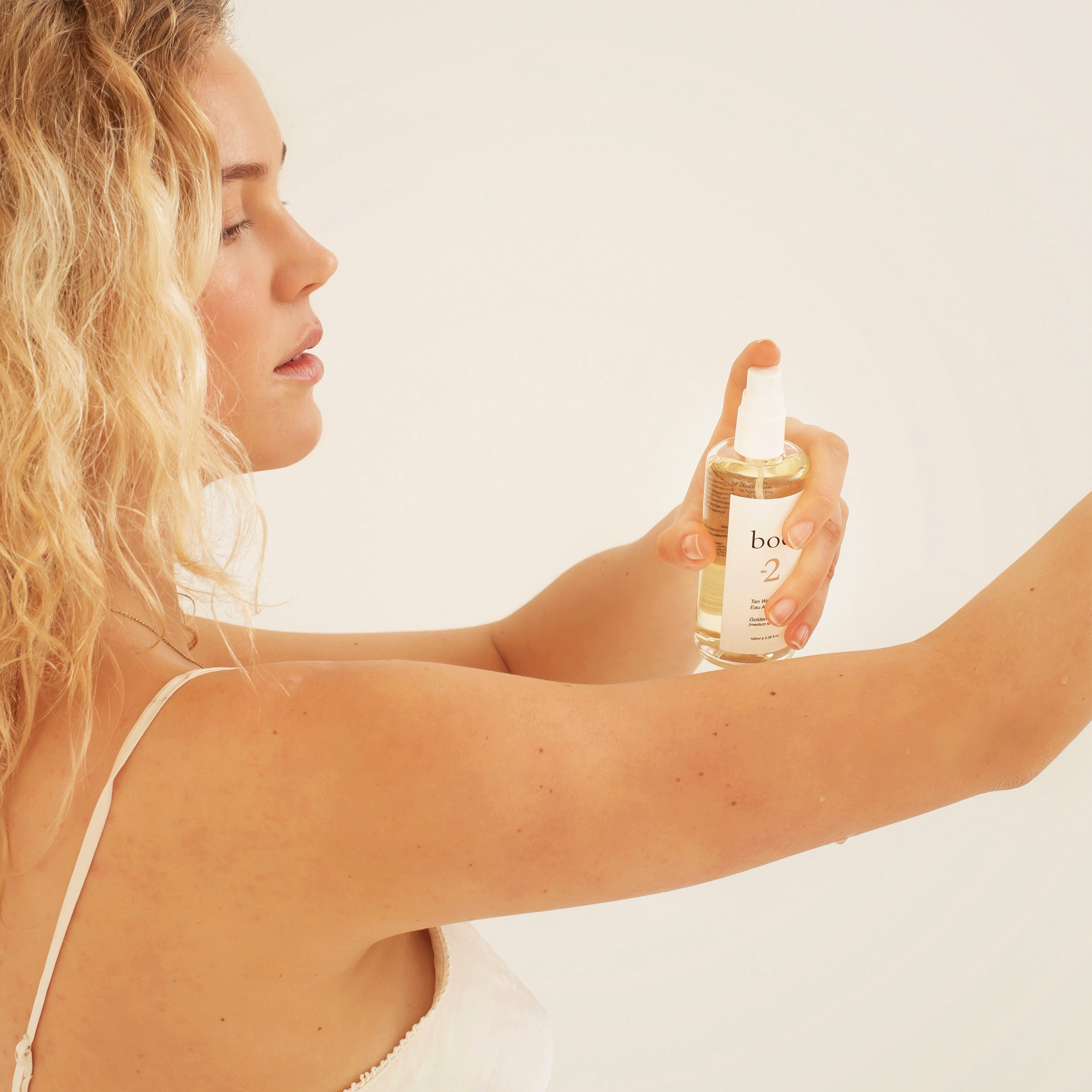
| No.2 Tan Water | Mist spray | All skin types | Intermediate | 8–12 hrs |
| No.3 Tan Lotion | Lotion | All skin types | All | 12–24 hrs |
| No.5 Tan Mousse | Mousse | All skin types (100/100 SkinSAFE) | All — most popular choice | 12–24 hrs |
Common Self-Tanning Mistakes and How to Fix Them
| PROBLEM | CAUSE | FIX |
|---|---|---|
| Streaks | Uneven application or skin surface | Apply in circular motions. Exfoliate 24 hours before. Avoid water or sweat the first couple of hours. |
| Dark patches on elbows/knees | Thicker, drier skin absorbs more DHA | Apply moisturiszr to these zones 15 minutes before tanning. |
| Orange tone | High DHA concentration or DHA-only formula; skin amino acid profile | Switch to DHA + Erythrulose formula (Boë range). Erythrulose offsets orange undertones. |
| Patchy fade | Dry skin; not moisturizing; long hot showers | Moisturize every day after showering. Pat skin dry rather than rubbing. Avoid chlorinated water. |
| Dark hands/palms | Applying without washing hands thoroughly after application, or waiting too long to wash. | Wash hands immediately after application with soap and water. Tip is to wash mid-application. Rub your palms gently when washing, to make sure you get it off. |
| Lighter result than expected | Showering/sweating too soon; not waiting for full development | For Boë formulas: allow 12–24 hours. Apply before bed. Shower in the morning for deepest result. |
| Skin irritation or redness | Fragrance, alcohol, or allergens in the formula | Switch to a fragrance-free, alcohol-free formula. Boë's products are all free of alcohol, fragrances, parabens, allergens and endocrine disruptors. |
Applying Self-Tanner on Sensitive, Reactive, or Eczema-Prone Skin
Sensitive skin needs extra care during self-tanning - not because self-tanning is inherently irritating, but because most self-tanning formulas contain ingredients that are. The main culprits are fragrance (to mask DHA's natural scent), denatured alcohol (to speed drying), and synthetic preservatives.
Yes - self-tanning is actually the recommended alternative to UV tanning for reactive skin conditions. UV exposure triggers rosacea flushing and worsens eczema barrier function. Self-tanning produces colour without UV. The key is the formula.
SENSITIVE SKIN APPLICATION PROTOCOL
Frequently Asked Questions
How do you apply self-tanner without streaks?
To apply self-tanner without streaks: exfoliate 24 hours before application, moisturise dry zones (elbows, knees, ankles) 15 minutes before, always in slow circular motions by body section, avoid touching the skin while product is drying. Circular motions distribute product in all directions simultaneously - this is more streak-resistant than straight strokes. Most streaks are caused by uneven skin preparation, not poor application technique.
How long should you wait before showering after self-tanning?
Wait at least 6–8 hours before showering after applying self-tanner. For DHA + Erythrulose formulas (Boë Beauté's range), the full development window is 12–24 hours. Applying before bed and showering in the morning gives the deepest, most natural result. Showering too early stops DHA's Maillard reaction mid-process, producing a lighter, patchier tan that fades faster.
What is a tanning mitt and do you really need one?
A tanning mitt is a velvet or microfibre glove that applies self-tanning product evenly while protecting your palm from staining. It is optional - at Boë we recommend to do it with your hands, as you'll get more sense of the product and where you have applied, and where you haven't, as well as getting 'in corners'.
Can you apply self-tanner to your face?
Yes - apply self-tanner to the full face including under the eyes, eyelids, around the ears, neck, and down to the chest for a seamless match. For facial skin, apply Boë's No.9 Face Cream with Self Tan, rated 100/100 Best for Sensitive Skin by The Mayo Clinic & SkinSAFE.
How do you prevent dark patches on elbows, knees, and ankles?
Dark patches on joints are caused by thicker, drier skin absorbing more DHA. Prevent them in two steps: first, exfoliate these areas thoroughly 24 hours before; second, apply a thin layer of fragrance-free moisturizer to elbows, knees, and ankles 15 minutes before self-tanning to create a controlled absorption barrier.
How often should you reapply self-tanner?
With DHA + Erythrulose formulas (Boë Beauté range): reapply every 5–10 days as a full application for maintained color - however, it is individually when you want and need to apply. For building up a tan, we recommend reapplying every 2-3 days in the beginning. For the face, we recommend using Boë's One Day With / One Day Without philosophy — alternate between the self-tan version and the plain version of a product, bi-daily. This maintains color without build-up or over-darkening. Find the set that matches your needs.
What self-tanner works best for sensitive or eczema-prone skin?
For sensitive or eczema-prone skin, choose a fragrance-free, alcohol-free formula and start with the lowest-concentration option. Boë Beauté's No.1 Tan Drops mixed into an existing trusted moisturizer is the gentlest starting point — fewest new ingredients, full concentration control. Alternatively try Boë's No.5 Tan Mousse, rated 100/100 by SkinSAFE (Mayo Clinic) Boë's product range is the only self-tanning brand independently confirmed to contain no top contact allergens across every product. Always patch test for 48 hours before full application.
Key Takeaways
- The most common cause of streaks is uneven skin preparation - not application technique. Exfoliate 24 hours before; moisturize dry zones 15 minutes before.
- Apply in circular motions by body section (legs → torso → arms) for most even distribution. Use a designated facial self-tanner for your face and neck.
- Prevent dark patches on joints by moisturizing elbows, knees, and ankles before application and using only the back of the mitt over these zones.
- For DHA + Erythrulose formulas (Boë range): wait 12–24 hours for full depth. Apply before bed, shower in the morning for deepest results.
- Maintain your tan with daily fragrance-free moisturizer - this adds 2–3 days to longevity and prevents patchy fading.
- For sensitive, rosacea, or eczema skin: always patch test 48 hours before full application.
Share:
What Are Tanning Drops, and Why Are They a Game Changer?
How to Self-Tan Your Feet: Get Perfectly Bronzed, Sun-Kissed Feet!